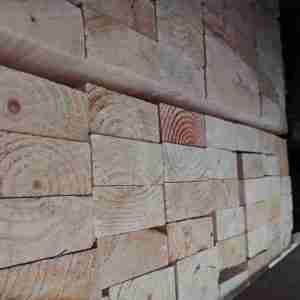
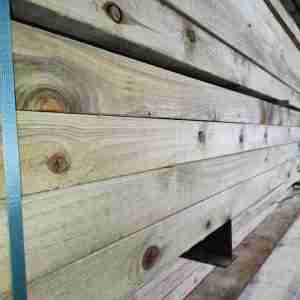
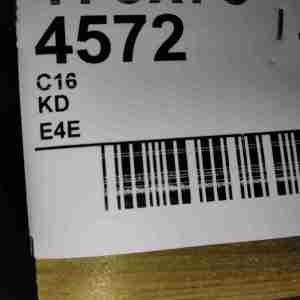
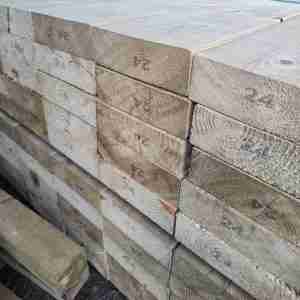
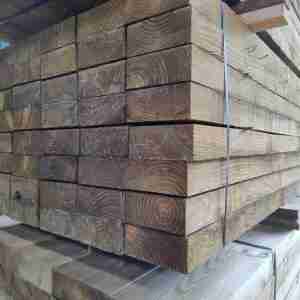
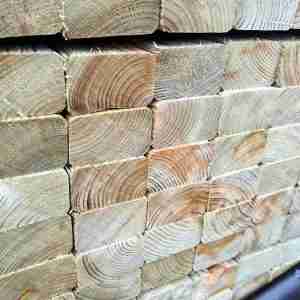
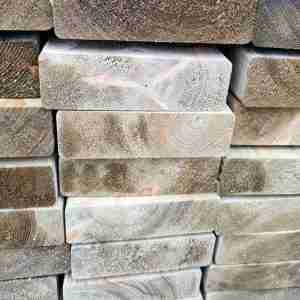
C16 timber is the industry-standard choice for structural applications where loads are moderate and engineering specifications allow for a standard strength grade. It is kiln-dried to reduce moisture content and available either untreated for dry internal use or pressure-treated (tanalised) for protection against decay.
What is C16 Timber?
C16 is a strength grade for softwood timber defined by European Standard EN 338. The “16” refers to its characteristic bending strength of 16 Newtons per square millimetre.
While C24 timber is a higher grade, C16 remains the most cost-effective solution for the majority of domestic and agricultural builds where shorter spans or moderate loads are required.
Key Applications & Use Cases
C16 timber is specified for a wide range of standard structural work:
Internal Framing: Stud walls, floor joists (within span limits), wall plates, and ceiling joists.
Outbuildings: Sheds, workshops, and summerhouse frames where structural certification is needed.
Agricultural Buildings: Purlins and cladding rails in barns and lean-tos.
Decking Sub-frames: When pressure-treated, the standard choice for supporting garden decking and boardwalks.
Performance & Compliance Standards
Every piece of C16 timber we supply is strength-graded in accordance with BS EN 14081, ensuring:
Building Control compliance for projects subject to local authority inspection, structural integrity through grading for bending, tension, and compression strength, and stability from kiln-drying to 18-20% moisture content.
C16 vs. C24: Choosing the Right Grade
It is essential to select the grade specified in your architectural drawings or structural calculations. C16 and C24 are not interchangeable.
| Feature | C16 Timber | C24 Timber |
|---|
| Strength Class | Standard | Premium |
| Best For | Stud walls, sheds, general framing | Main floor joists, long spans, high loads |
| Typical Span (4×2 joist at 400mm centres) | ~2.5m | ~2.9m |
| Cost | More economical | Higher price point |
Important: If your plans specify C24, C16 must not be used as a substitute.
For detailed span comparisons, read our article: C16 vs. C24 Timber: Making the Right Structural Choice
Treatment Options: Untreated vs. Tanalised
Untreated (White Wood): For dry, internal applications like partition walls, ceiling joists, and protected roof structures. Kiln-dried but no chemical preservative.
Tanalised (Pressure-Treated): Required for timber exposed to the elements or ground moisture. Our tanalised treatment protects against rot and insect attack. Essential for decking frames, garden buildings, and agricultural structures.
Simple rule: If it sees moisture, use tanalised. If it’s internal and permanently dry, untreated is sufficient.
Why Trade & DIY Choose Ryedale Timber
No Silent Substitution: You get the exact grade you ordered, every time. We don’t supply C16 when you’ve ordered C24, or vice versa.
Straight & Square: We manage our own yard in Pickering to ensure stock is stored correctly and remains usable.
Local Expertise: Deal directly with people who understand construction and agricultural requirements across North Yorkshire.
C16 Structural Timber: Local Expertise & Quality
C16 timber is the industry standard for domestic and agricultural framing. At Ryedale Timber, we manage our own yard in Pickering to ensure every length is stored correctly, remains straight, and meets structural grading requirements.
We specialise in serving trade and DIY customers across North Yorkshire and East Yorkshire. Our dedicated fleet provides reliable, fixed-price delivery to York, Scarborough, Malton, and Thirsk. We also regularly supply projects in Driffield, Bridlington, Whitby, and Filey.
For rural and coastal builds, we deliver to Helmsley, Kirkbymoorside, Easingwold, Pocklington, Guisborough, and Robin Hood’s Bay.
Choose between untreated timber for dry internal studwork or tanalised (pressure-treated) timber for external frames, sheds, and agricultural buildings. If your plans require a higher load-bearing capacity, we also stock premium C24 grades.
Timber Delivery: North Yorkshire & East Yorkshire
We deliver our full range of C16 to the following areas. Deliveries typically take 3–5 working days.
| Delivery Area | Postcodes Covered | Flat Rate | Minimum Spend |
|---|
| Pickering | YO18 | £5.00 | £50 |
| Malton | YO17 | £10.00 | £100 |
| Scarborough | YO11, YO12, YO13 | £10.00 | £100 |
| Filey | YO14 | £12.00 | £100 |
| Helmsley | YO62 | £15.00 | £150 |
| Kirkbymoorside | YO62 | £15.00 | £150 |
| Bridlington | YO15, YO16 | £15.00 | £200 |
| Whitby | YO21 | £20.00 | £200 |
| Robin Hood’s Bay | YO22 | £20.00 | £200 |
| Driffield | YO25 | £30.00 | £300 |
| York | YO1, YO10, YO19, YO23, YO24, YO26, YO30, YO31, YO32, YO43, YO44, YO51, YO60 | £30.00 | £300 |
| Easingwold | YO61 | £30.00 | £300 |
| Thirsk | YO7 | £35.00 | £300 |
| Pocklington | YO41, YO42 | £35.00 | £350 |
| Guisborough | TS14 | £40.00 | £500 |
Related Timber Products
Depending on your project, you might also need:
Frequently Asked Questions
What does C16 mean on timber?
C16 is a structural strength grade for coniferous softwood (indicated by the “C”). The “16” represents a characteristic bending strength of 16 Newtons per square millimetre. Every piece of C16 timber from Ryedale Timber is kiln-dried to a moisture content of 18–20% and graded in accordance with BS EN 14081 to ensure it meets UK Building Regulations.
Can you use C16 for joists?
Yes, C16 is the industry standard for floor and ceiling joists in domestic builds. As a guide, a 4×2 (100x50mm) C16 joist at 400mm centres spans approximately 2.5 metres. For longer spans or higher loads, you must increase the depth of the timber (e.g., 6×2 or 8×2) or switch to a C24 grade.
Is C16 suitable for outdoor use?
Only if it is pressure-treated (tanalised). Untreated “white wood” C16 is for internal, dry use only (such as stud walls). For garden buildings, decking sub-frames, or agricultural projects, you must use tanalised C16 to protect against rot, fungal decay, and insect attack.
Is C16 better than C24?
Neither is universally superior; the choice depends on the structural requirement. C24 is a higher grade with fewer knots, allowing for longer spans and higher loads, but it carries a higher price point. C16 is more economical and perfectly sufficient for most standard domestic framing and agricultural applications where engineering specifications allow.
What size C16 timber do I need?
Timber sizes are generally sold in “nominal” (pre-milled) dimensions. Common applications include:
- Stud Walls: 3×2 (75x50mm) or 4×2 (100x50mm)
- Floor Joists: 4×2 for spans under 2.5m; 6×2 (150x50mm) or 8×2 (200x50mm) for larger rooms
- Ceiling Joists: 4×2 for standard domestic ceilings
- Purlins: 7×3 (175x75mm) or 9×3 (225x75mm) depending on the roof span
Always check your structural drawings or Building Regulations for specific requirements.